5 signs you need a roof repair vs. full replacement
Published March 19, 2026 · 6 min read
You found a leak, noticed some missing shingles, or maybe your energy bill jumped and you are wondering if the roof is to blame. The question everyone lands on is the same: can I fix this, or do I need a whole new roof?
There is no single answer that works for every house, but there are patterns. Here are five things that reliably point you in one direction or the other.
Whether to repair or replace your roof depends on the age of your roof, the extent of the damage, and how often problems keep coming back. If your roof is under 15 years old and damage is limited to one area, a repair is usually the right call. If your roof is 20-plus years old, has widespread wear, or the same leak keeps returning after fixes, replacement will save you more money in the long run and give you 25 to 30 years of coverage.
What this guide covers:
- How roof age affects whether repair or replacement makes sense
- The difference between localized damage and whole-roof failure
- Why recurring leaks signal a deeper problem
- Structural warning signs like sagging decking
- How to run the math on repair costs vs. replacement cost
1. Your roof is past its lifespan
Asphalt shingles last 20 to 30 years depending on the quality. Metal roofs go 40 to 70. According to the Insurance Institute for Business & Home Safety (IBHS), roof lifespan varies significantly by material and installation quality. If yours is within a few years of its expected end of life and something goes wrong, repair buys you time but replacement is coming regardless.
Putting $1,200 into patching a 25-year-old asphalt roof makes sense if you are selling the house next month. If you plan to stay, that $1,200 is gone and you will still need to replace it soon. Be honest with yourself about the timeline.
2. The damage is in one spot vs. everywhere
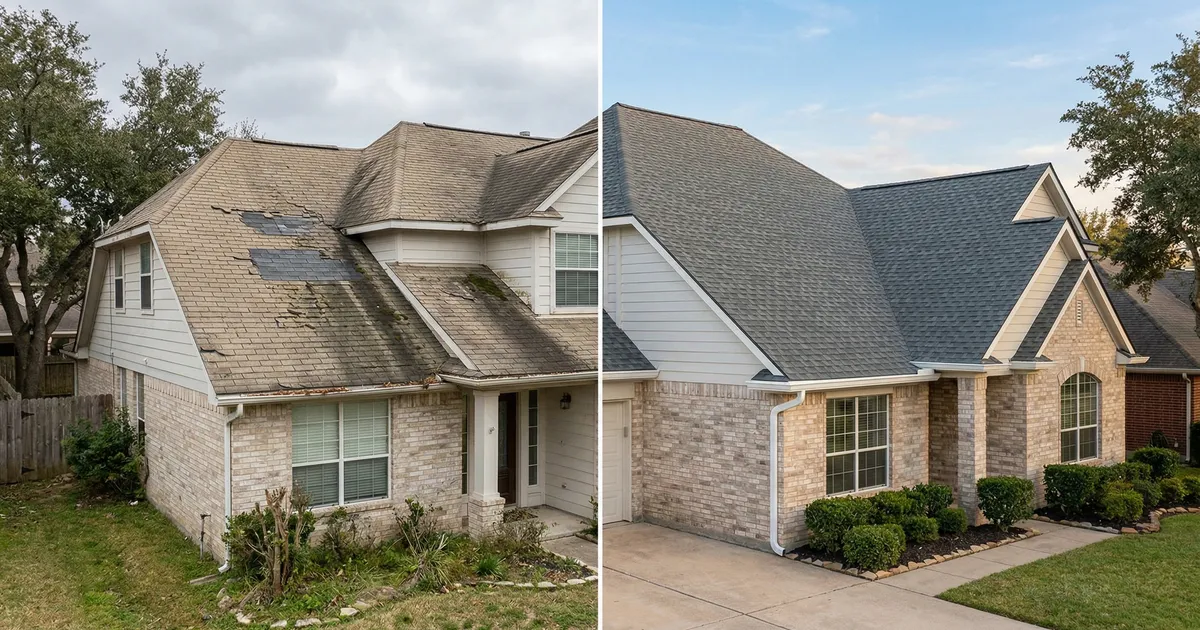
A tree branch punches through one section of your roof. A few shingles blew off on the south-facing slope. These are repair situations — the same goes for storm damage that hit one area but left the rest intact. The rest of the roof is fine and the fix is localized.
But if you are finding problems on multiple slopes, if there are worn spots scattered across the whole surface, or if the granules have washed off uniformly, the issue is not one bad spot — it is the whole roof aging out. Patching random areas of a roof that is failing everywhere is like putting bandaids on a sunburn.
3. You have had the same leak fixed more than once
A recurring leak in the same spot after repair usually means the problem is deeper than the surface. It could be failing flashing around a vent or chimney, deteriorated underlayment, or a structural issue with the deck underneath. One repair is expected. Two is a yellow flag. Three times in the same area and you are throwing money at a symptom while the cause keeps doing damage.
Not sure if you need repair or replacement?
We inspect your roof and give you an honest recommendation — no pressure either way. Schedule a free inspection or call (832) 661-6272.
4. The decking is sagging
Walk outside and look at your roofline from the street. It should be straight. If you see a dip, a sag, or a section that looks like it is bowing, the plywood decking underneath has likely been compromised by moisture. That is not a shingle problem — that is structural. Sagging decking almost always means replacement, because you cannot fix the surface without first fixing what it sits on.
5. Your energy bills are climbing for no obvious reason
A roof that is past its prime loses insulation value. Hot Texas air pushes through worn shingles and degraded underlayment, making your HVAC work harder. Energy Star notes that reflective roofing materials can cut cooling costs measurably in hot climates. If your energy usage has crept up and the AC unit is not the problem, the roof may be. This is one of those things homeowners do not connect — they replace the thermostat or add weatherstripping when the real issue is overhead.
The math on repair vs. replacement
Repairs cost $300 to $1,500 in most cases. A full replacement is $8,500 to $22,000. The gap is large enough that repair is always tempting. But here is the calculation most people skip: if your roof is 20+ years old and you spend $1,000 a year on repairs, by year three or four you are approaching what you would have spent on a new roof that would last another 25 to 30 years.
We are not saying always replace. A 10-year-old roof with a small leak? Repair it, move on with your life. A 22-year-old roof where things keep popping up? Do the math forward, not backward.
Get a straight answer
We inspect a lot of roofs in Baytown and the surrounding area. Sometimes we tell people to repair. Sometimes we tell them to replace. We do not have a financial incentive to push you toward one or the other — both keep us working.
If you want someone to look at your roof and give you an honest read on which way to go, call us at (832) 661-6272 or schedule a free inspection. We will tell you what we see and let you decide.
FAQ
Frequently Asked Questions
Should I repair or replace my roof?
How much does a roof repair cost compared to replacement?
Can I just replace part of my roof?
How do I know my roof's age?
Will my insurance company decide for me?
Contact Us
Ready to Get Started?
Contact us today for a free estimate. We're here to help with all your roofing and construction needs.
Phone
(832) 661-6272
tacremodeling@gmail.com
Address
410 Bayou Bend Dr
Baytown, TX 77521
Business Hours
Monday - Friday: 8AM - 6PM
Saturday: 8AM - 2PM
Get Your Free Estimate
Share your project details, then choose text, email, or call to contact TAC.
Next, choose text, email, or call. Nothing sends automatically.