
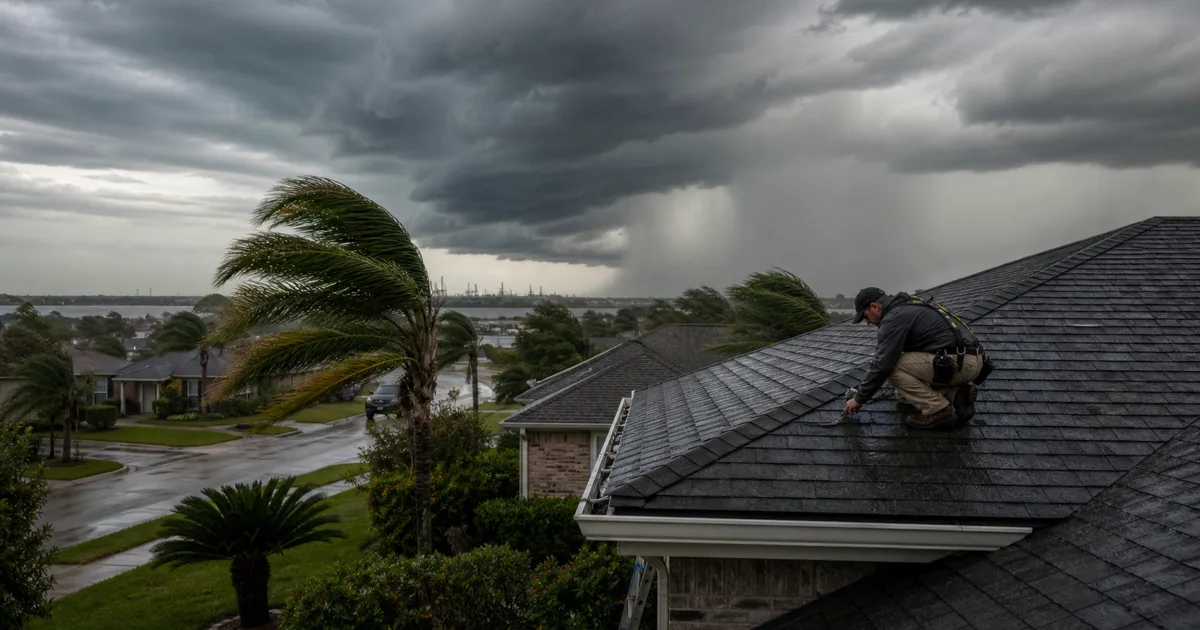
Hurricane prep checklist for Baytown homeowners (2026)
Published April 23, 2026 · Updated June 30, 2026 · 9 min read
Hurricane season is underway. For Baytown, Mont Belvieu, La Porte, and the rest of the Texas Gulf Coast, June is the handoff from pre-season prep to active-season readiness: tighten up roof and drainage issues now, keep documentation current, and know who to call if water starts coming in.
To prepare your Baytown home for hurricane season, you should: (1) schedule a professional roof inspection before the next major system, (2) clean gutters and downspouts of debris, (3) trim trees within 10 feet of the roof, (4) photograph the exterior and interior of your house for insurance baseline, (5) review your homeowner's policy declarations page, especially the wind/hail deductible, (6) update your emergency supply kit, and (7) confirm your evacuation route and family communication plan.
- What to do before the season starts (April–May)
- Roof, gutter, and tree prep that actually matters
- Insurance and documentation work most homeowners skip
- What to do during a watch and a warning
- The first 48 hours after a storm passes
We cover storm response in a separate guide — what to do after a hailstorm hits your Baytown home. This piece is about the work you do before the storm.
Already dealing with water inside?
Switch from prep mode to leak response. Start with our emergency roof leak guide and request temporary roof tarping if the roof is exposed.
Step 1: Schedule a roof inspection before peak activity
The single highest-leverage thing a Gulf Coast homeowner can do for hurricane prep is have a contractor walk the roof before peak storm activity. Loose flashings, lifted shingles around vents, missing nails, and clogged drains are the kind of small failures that turn a survivable storm into a five-figure insurance claim.
An inspection takes 30 to 60 minutes, costs nothing at most reputable companies, and produces a written report you can match against post-storm damage if a claim becomes necessary. We do free inspections in Baytown and the surrounding service area — request one online or call us at (832) 661-6272.
Step 2: Clean gutters and check drainage
A hurricane drops 6 to 12 inches of rain in 24 hours. If your gutters are full of leaves and seed pods from spring, that water has nowhere to go but down the wall, into the soffits, and through whatever path of least resistance it can find — usually inside.
Clear every gutter run, flush downspouts with a hose to confirm they drain, and walk the perimeter to make sure water is moving away from the foundation, not toward it.
Step 3: Trim back trees and remove dead limbs
Anything within 10 feet of your roof can become a projectile in a Category 1 wind event. Walk your property and remove dead branches. If a tree limb is overhanging the roof, get it shortened. If a tree is dead or dying, get it down before the season starts — once a watch is issued, every tree service in the metro is booked solid.
Step 4: Document the property for insurance baseline
Pre-storm photos are some of the most valuable evidence you can have. Walk every room and shoot video. Open closets and cabinets so contents are visible. Step outside and photograph all four sides of the house, the roof from ground level, the AC unit, fences, sheds, and outbuildings.
Save the photos somewhere that survives the storm — cloud storage, an email to yourself, a thumb drive at a relative's house out of the area. The Texas Department of Insurance has a free pre-storm checklist that's worth printing.
Step 5: Read your homeowner's policy
Most Texas homeowner policies have a separate wind/hail deductible, often 1% to 2% of dwelling coverage. Some policies in coastal counties have moved to 5%. On a $300,000 dwelling policy, that's $15,000 out of pocket before insurance pays a dollar.
Find your declarations page now and confirm:
- Dwelling coverage amount
- Wind/hail deductible (percentage and dollar amount)
- Whether you have flood insurance separately (most homeowner policies don't cover flood)
- Your agent's after-hours claim phone number
- The deadline for filing claims (usually one year, sometimes shorter)
If you find a gap, call your agent. If your deductible is higher than you can comfortably absorb, ask about roof financing — it's an option for the gap between your deductible and the work needed.
Step 6: Build (or refresh) your supply kit
The standard recommendation is one gallon of water per person per day for at least three days, and three to seven days of non-perishable food. A few additions that matter on the Gulf Coast specifically:
- Battery-powered or hand-crank radio (cell towers go down)
- Flashlights and a stash of extra batteries
- Cash in small bills (ATMs and card readers fail with no power)
- Phone chargers including a power bank or two
- Important documents in a sealed plastic bag (insurance policy, IDs, medication lists)
- Tarps, plastic sheeting, and duct tape — for emergency mitigation only
Step 7: Confirm your evacuation route and family plan
Harris and Chambers counties have evacuation zones. Know yours. ReadyHarris maps the zones online. Pick a meet-up point outside the storm area in case you and your family get separated, and pick someone out of state to be the central contact — long-distance lines often work when local ones don't.
Need a storm-season roof inspection?
TAC Construction offers free roof inspections in Baytown and surrounding areas. Schedule before the next storm system turns a small issue into an active leak. Book yours today or call (832) 661-6272.
When a watch turns into a warning
Hurricane watch means storm conditions are possible within 48 hours. Finish prep, check supplies, fuel the car, charge devices.
Hurricane warning means conditions are expected within 36 hours. Bring loose items inside or secure them — patio furniture, planters, garbage cans, kids' toys. Move vehicles to higher ground if you're in a flood-prone area. If you're in an evacuation zone, leave.
After the storm passes
Wait until officials clear the all-clear before going outside. Watch for downed power lines and call CenterPoint Energy at 713-207-2222 if you see one. Document damage from the ground first with date-stamped photos, then call your insurance company to start a claim.
For storm-specific response steps, see our companion guides on what to do after a hailstorm and our insurance claims help page.
Quick reference timeline
| When | What to do |
|---|---|
| April | Schedule roof inspection, review insurance policy |
| May | Repairs, gutter cleaning, tree trimming, documentation photos |
| Memorial Day | Supply kit refreshed, evacuation plan confirmed |
| June 1 | Season opens - shift from prep to monitoring forecasts and leak readiness |
| During storm season | Monitor NHC forecasts, act on watches and warnings promptly |
We do pre-season inspections every year
In April and May, we run free roof inspections across our service area. We check the surface, flashings, ventilation, gutters, and any visible damage from the previous winter. You get a written report with photos and, if there's anything to fix, a clear estimate. Most homes are good to go for the season; the ones that aren't usually need under $1,000 of small fixes that prevent five-figure storm claims.
Call us at (832) 661-6272 or book a free inspection.
FAQ
Frequently Asked Questions
When does hurricane season start for Baytown, TX?
What's the most important roof prep for a hurricane?
Should I tarp my roof before a hurricane?
What does my insurance cover for hurricane damage in Texas?
Can I file a claim before the storm hits?
How long should I wait after a hurricane to inspect my roof?
Contact Us
Ready to Get Started?
Contact us today for a free estimate. We're here to help with all your roofing and construction needs.
Phone
(832) 661-6272
tacremodeling@gmail.com
Address
410 Bayou Bend Dr
Baytown, TX 77521
Business Hours
Monday - Friday: 8AM - 6PM
Saturday: 8AM - 2PM
Get Your Free Estimate
Share your project details, then choose text, email, or call to contact TAC.
Next, choose text, email, or call. Nothing sends automatically.